
Performance Check
Does your flashlight/headlamp live up to its specifications? Try the Performance check!
Suprabeam Performance Check
Does your flashlight/headlamp live up to its specifications? Try the Performance check!
The Performance Checker is a calculation tool that allows you to test if a flashlight or headlamp can actually live up to the specifications promised by the manufacturer. So if you are planning a purchase or want to test your own light, type in the specifications to test it.
Runtime lumen calculator
0 lm
The average lumen is calculated: Watt hours / runtime * 110. Why 110? The flashlight/headlamp will produce approximately 110 lumen per watt. Modern LED chips might show 150-190 lumen per watt on paper, but this is without taking loss into account. Loss mainly comes from wiring, optics, and temperature. LED chips are typically marketed with a lumen per watt number measured at 25° Celsius, while most flashlights/headlamps runs the LED at 80° Celsius due to the heat build-up within the light. This affects the efficiency of the LED significantly and is why we have chosen to set the LED efficiency at 110 lumen per watt. Another important factor is whether or not the specifications are actually measured in accordance with the ANSI FL-1 standard. We see many creative ways of measuring specifications, which bend or break the rules of the ANSI FL-1 standard. The standard states that the temperature in the test environment must be 23° +/- 3°; however, in some cases the flashlight/headlamp is fan cooled which boosts the performance. Some flashlights/headlamps have temperature control which dims down the light to prevent the lamp from getting too hot, which is a very useful feature. However, we have seen specifications where the manufacturer has disabled the temperature control before measuring, to make the light perform better in the test. The end-user cannot disable the temperature control, and the product therefore performs worse in reality than in the test.
Where do you find the specifications?
It differs from manufacturer to manufacturer where you can find the information to type in.
Lumen can be found on the packaging and on the manufacturers website. It might also be in the product manual.
Runtime can be found on the packaging and on the manufacturer’s website. It might also be in the product manual.
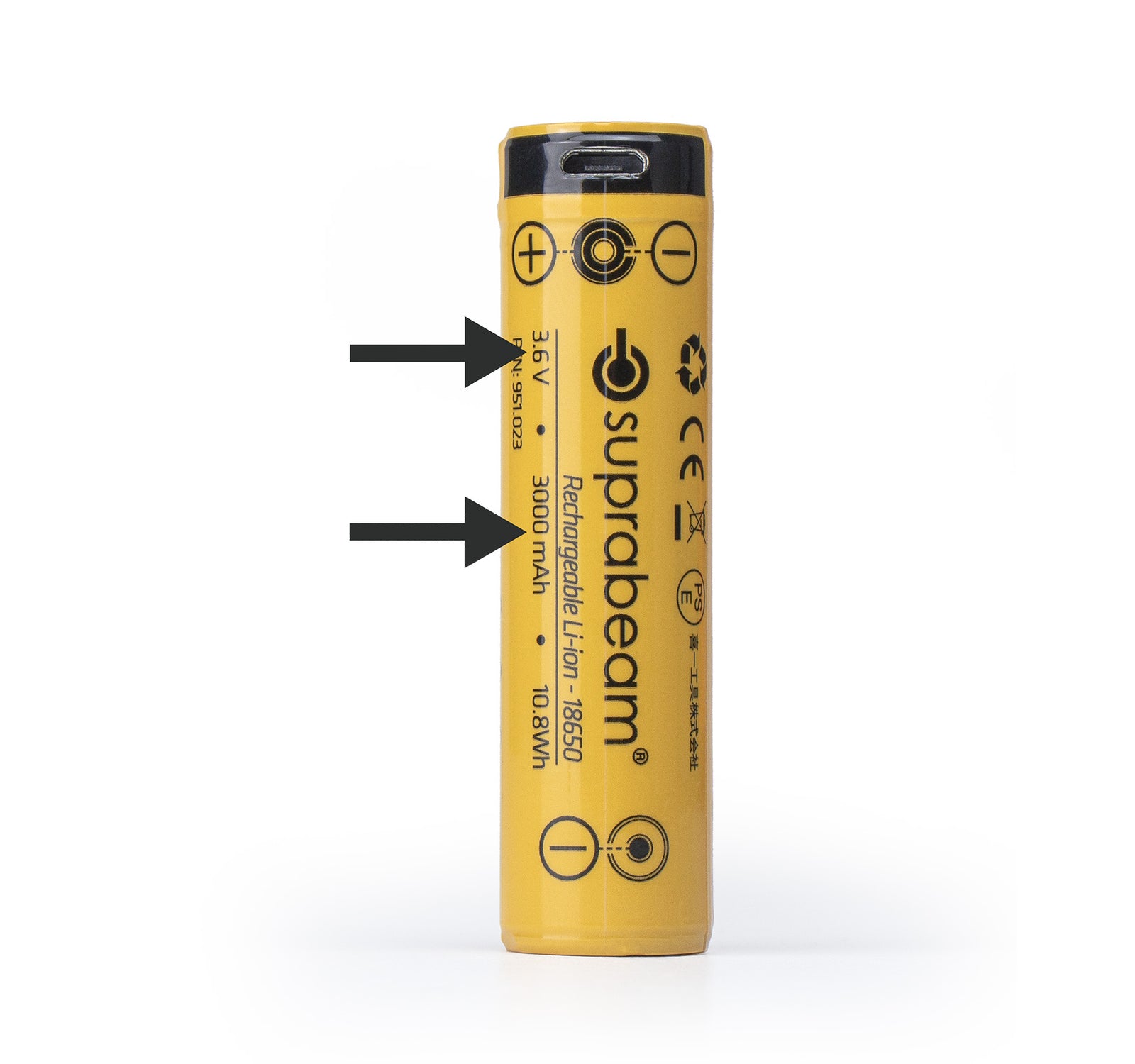
Battery capacity (mAh) Can be found on the battery itself, and is most likely also on the manufacturer’s website.
Voltage Can be found on the battery itself, and is most likely also on the manufacturer’s website.
Wh Can be found on the battery itself, and is most likely also on the manufacturer’s website.
Battery capacity calculator
Convert watt-hours to milliamp-hours.